
Dozens of states have joined Ukraine in condemning ballistic missile and other weapons transfers between North Korea and Russia, arguing that the two countries are violating United Nations sanctions.
The joint declaration sees the signatures of 47 countries, including the United States, numerous European Union member states and the United Kingdom, together with Argentina, Japan and South Korea.
Table of Contents
Exchange of arms between Moscow and Pyongyang
Josep Borrell, EU High Representative, speaking to the press, underlined that cooperation between Moscow and Pyongyang would also provide technical and military insights to North Korea.
“We are deeply concerned about the security implications this cooperation has in Europe, on the Korean Peninsula, throughout the Indo-Pacific region and around the world,” he said. NATO countries and their allies plan to raise the issue at the United Nations Security Council on January 10.
“The transfer of ballistic missiles, together with any other weapons and related material, from the DPRK to Russia blatantly violates multiple UN Security Council resolutions […] which Russia itself has supported,” explains the joint statement, in which specifies that the signatory countries are “closely monitoring what Russia provides to North Korea in exchange for these arms exports”.
Kremlin spokesman Dmitry Peskov declined to comment on the allegations relating to the arms transfers. Missing from the roll call of EU member states is Viktor Orban’s Hungary. The country continues to forge intense relations with the Kremlin and in December got in the way of the EU funds to be sent to Kiev.
More intense relations between Putin and Kim Jong Un
Reports have emerged since 2022 about Moscow’s plans to purchase weapons from North Korea for use in the invasion of Ukraine. In August last year, US UN envoy Linda Thomas-Greenfield told the organization that Moscow was negotiating “potential deals for significant quantities and multiple types of munitions”.
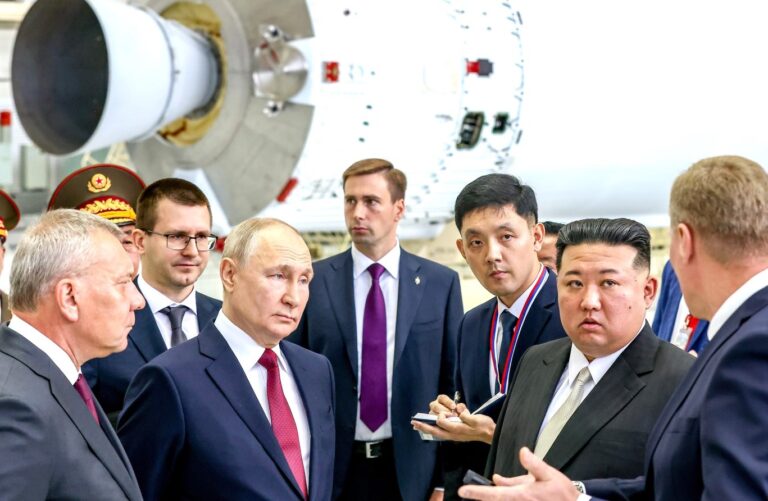
The following month, Vladimir Putin and Kim Jong Un met during a summit at the Vostochny Cosmodrome, Russia’s most important satellite launch center and a symbol of Russian space ambitions.
Putin claimed that Moscow would help Pyongyang build satellites, while the North Korean dictator promised his support for what he called Russia’s “just fight”, with an implicit reference to Ukraine. At that point, speculation intensified regarding an agreement between the two countries for the exchange of weapons.
Spy satellites and ballistic missiles
In November, North Korea announced the success of its first military spy satellite, raising the alarm in Washington, Tokyo and Seoul. On December 31, Kim Jong Un announced that he plans to launch three more this year.
In early January, Pyongyang fired about 200 artillery shells off its western coast. The danger was such that Seoul ordered civilians on the islands of Yeonpyeong and Baengnyeong to evacuate. Analysts fear that relations between the two Koreas risk deteriorating rapidly.
Around the same time, between Christmas and New Year, Russia stepped up missile and drone launches against Ukraine, saying it targeted factories, weapons repair centers and other military facilities, particularly in the Zaporizhzhia and Kharkiv areas, the second largest city in Ukraine.
In reality the buildings hit and the victims are often civilians. To keep the pressure on Kiev high, a total of 125 ballistic missiles have been launched since the beginning of the year.
Read also: North Korea, what is life like in one of the most closed and authoritarian countries in the world