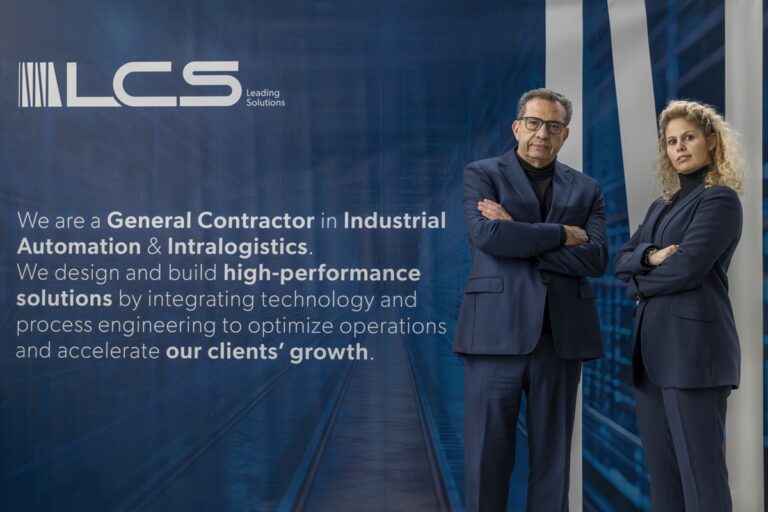
There are moments in the life of a company when stopping, looking in the mirror and designing a new image of oneself is an act of great awareness and lucidity. For LCS Group, that moment arrived in 2025. After almost forty years of history, challenges and continuous innovation, the group founded by Gianfranco Silipigni has chosen to present itself with a new face. A major rebranding that does not change what LCS is, but organises it, amplifies it and projects it into the future, thanks in part to the arrival of his daughter Camilla, currently the Group’s Corporate Strategist.
The history of LCS began in the late 1980s, when the world of industrial automation was undergoing an epoch-making transformation. It was a time when microprocessors were invading the market, wired logic was giving way to programming, and codes and software were becoming the new language of efficiency, precision and speed. Gianfranco Silipigni, then a young university student, immediately understood the significance of this revolution. He understood that technology was no longer just a tool, but organised thinking, method and vision, and this insight led him setting up a consultancy business for large international companies. This is where the idea for LCS took shape: an orchestra of excellence, an innovative and technological tailor that sews high-class suits to suit the needs of businesses, a company that combines engineering logic and software. Over the years, that small business became a reality capable of designing and implementing automation systems for internal logistics, building intelligent handling, storage and control systems. Growth was rapid, and LCS began to integrate new skills, acquire specialised companies and create a network of subsidiaries that added excellence and know-how. The goal is clear: to offer complete, customised and scalable solutions capable of responding to the challenges of complex and diverse sectors – from airports to automotive, from distribution to e-commerce, from textiles to food, from chemicals to pharmaceuticals.
“LCS Group is nothing more than an ecosystem of interconnected skills that goes far beyond the parent company LCS SpA, the technological and strategic heart of the group”, says the CEO. “Today, LCS SpA is a leading system integrator in the industrial automation landscape: a partner capable of understanding customer needs and devising the most suitable solution. From mechanical and electrical design to software development, everything is done in-house, with meticulous attention to detail and total control of the process. But the real strength of the group lies in its network of subsidiaries and specialised business units that complete the offering. LCS 4Next, dedicated to the development of software for the digitalisation of the logistics industry, LCS HTecno, which produces customised components and technologies for intralogistics handling, and LCS Automation, specialising in robotic automation and electrical and pneumatic systems for intralogistics and general industry. A galaxy of companies that revolve in perfect harmony around the customer, studying the best solutions and developing prototypes capable of meeting every handling need.
Speaking of cutting-edge technology, LCS SpA has just invested in an innovative start-up that develops software for managing fleets of AGV/AMR vehicles. It is called Fluid and promises to mark an important step forward in the sector. “Fluid is the ultimate expression of our attempt to facilitate technological inclusion”, says Silipigni. “Thanks to the use of VDA 5050, a standardised interface created at European level for AGV communication, we can enable robots and vehicles from different manufacturers to speak the same language and thus share the same operating space. It is a small revolution in logistics 4.0: an open, interoperable model which, combined with a sophisticated proprietary algorithm, is capable of avoiding so-called deadlocks.”
In short, in recent years, the Group has worked tirelessly to make life inside and outside the factory more sustainable, offering a service that is attentive to technological innovations and timely in managing the obsolescence of systems with very long life cycles. All this, on the other hand, has led to an increase in skills both from an organisational point of view and in terms of their complexity. “The rebranding launched in 2025 aims precisely to bring order to this complexity”, explains Camilla Silipigni. “It is the natural outcome of a journey, the answer to a demand for clarity: who is LCS Group today, and how does it present itself to the world? Over the years, skills have multiplied, and the companies acquired have brought value, but also new management needs. The new brand serves to unify languages, processes, communication and identity. It is a work of organisational and cultural architecture, rather than aesthetics. A new grammar to tell an industrial story that continues.”
The new advances without losing sight of its roots, combining tradition and innovation. Today, LCS Group is a solid reality that looks ahead with the same curiosity with which it was born. The rebranding is a symbol of this maturity: a bridge between the source code of the 1980s and today’s artificial intelligence. It is the story of an Italian company that has been able to grow by reading the times, that has turned complexity into a competitive advantage, that has chosen to organise its areas of excellence in order to continue building future paths. Because for LCS, change does not mean abandoning what you are, but giving shape and language to what you have become. And telling the story with the same passion with which it all began forty years ago.
For more information, visit www.lcsgroup.it or write to info@lcsgroup.it